
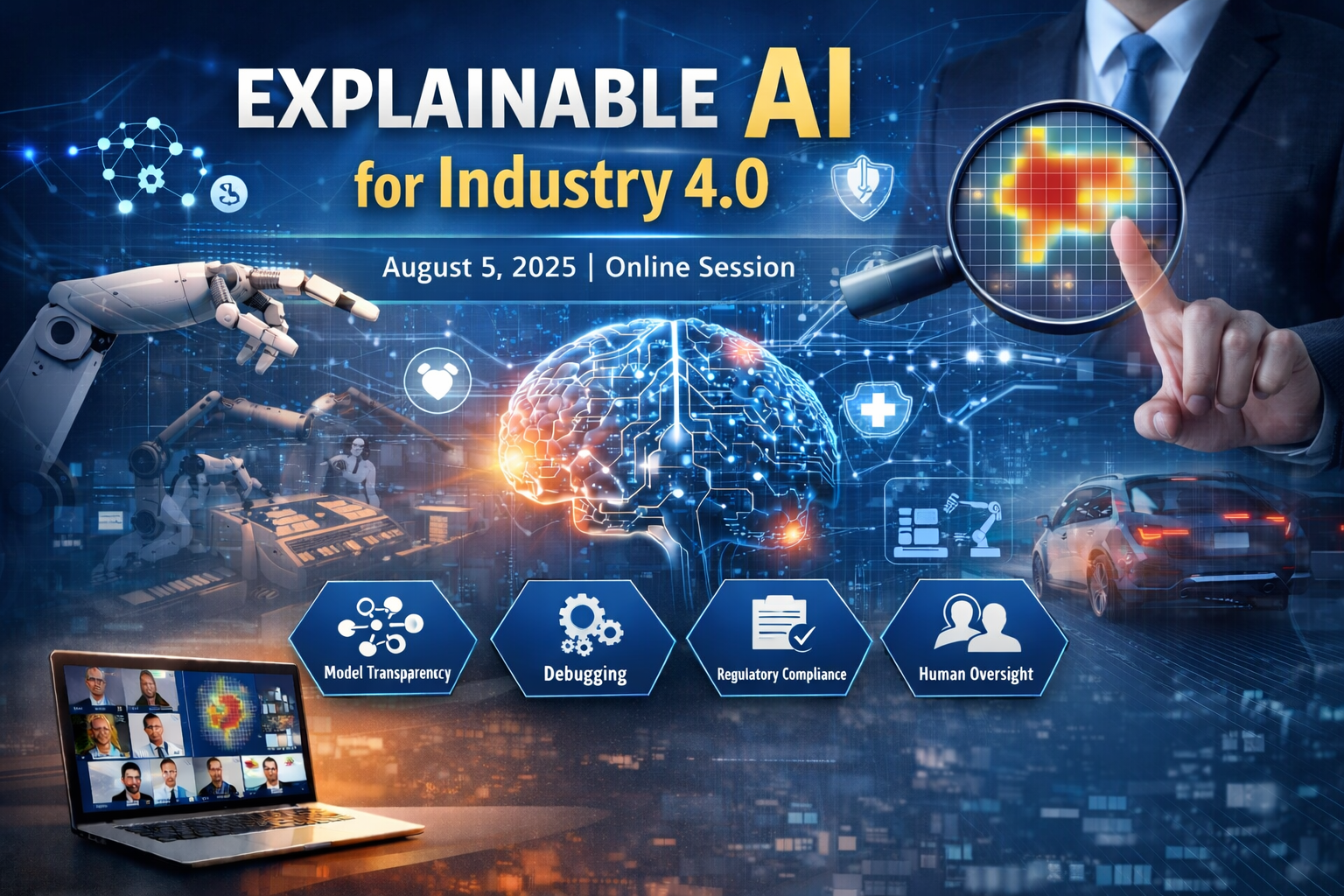

Explainable AI (XAI) for Industry 4.0
ICT-based STC on “AI for Industry 4.0” – NITTTR Chandigarh
On August 5, 2025, a online session on Explainable AI (XAI) for Industry 4.0 was delivered as part of the One Week ICT-based Short-Term Course (STC) on “AI for Industry 4.0”, organized by the Department of Computer Science & Engineering, NITTTR Chandigarh, held from August 4–8, 2025.
The session focused on the critical role of explainability in AI-driven systems that power Industry 4.0 applications. While Industry 4.0 brings autonomous machines capable of real-time decision-making, trust and accountability are paramount. For example, when an AI system predicts “this motor will fail next week” or flags a defective component on an assembly line, engineers and operators must be able to understand why. This is where XAI becomes indispensable—transforming black-box models into transparent systems that foster trust, compliance, and effective human–machine collaboration..
Participants explored how XAI strengthens safety, reliability, fairness, and regulatory compliance across sectors such as manufacturing, healthcare, energy, transportation, and surveillance. Without explanation mechanisms, AI predictions are often questioned, regulatory approval becomes difficult, and operational adoption slows. XAI enables insight into model behavior, supports debugging, and builds confidence in deploying AI solutions within critical industrial workflows.
The session introduced core XAI concepts, including what aspects of AI systems require explanation, different forms of explanations such as feature importance, saliency maps, surrogate models, and counterfactuals, and the distinction between model-specific and model-agnostic approaches.
A hands-on example showcased an AI-powered defect detection system using ResNet and Grad-CAM with a metal surface dataset. Participants saw how heatmaps can visualize AI predictions, ensuring both accuracy and trust in industrial automation scenarios. Options for applying XAI with low-code/no-code platforms were also demonstrated, making these techniques accessible even without deep programming expertise.
Gratitude is extended to NITTTR Chandigarh and the Department of Computer Science & Engineering for organizing this forward-looking ICT-based STC. Special thanks to Dr. Amit Doegar, Associate Professor, for his kind invitation and coordination of the program. Appreciation is also extended to the faculty and all participants for their enthusiastic engagement, curiosity, and insightful questions, which made the session highly interactive and enriching.