

Bridging Accessibility and Trust in Computer Vision through No-Code AI and XAI
"ATAL Online Faculty Development Programme (FDP) 2025–26” – TIT, Narsingarh, Tripura
As part of the ATAL Online 6-Day Faculty Development Programme (FDP) 2025–26 organized by Department of Computer Science & Engineering, Tripura Institute of Technology, Narsingarh, Agartala Aerodrome, Tripura under the thrust area “Advanced Computing (Supercomputing, AI, Quantum Computing)”, two sessions were delivered during the FDP titled “Deep Learning for Computer Vision”, conducted from 03 November to 08 November 2025. The sessions aimed to enhance faculty understanding of modern computer vision techniques by combining accessibility through no-code tools with advanced concepts of explainability in deep learning.
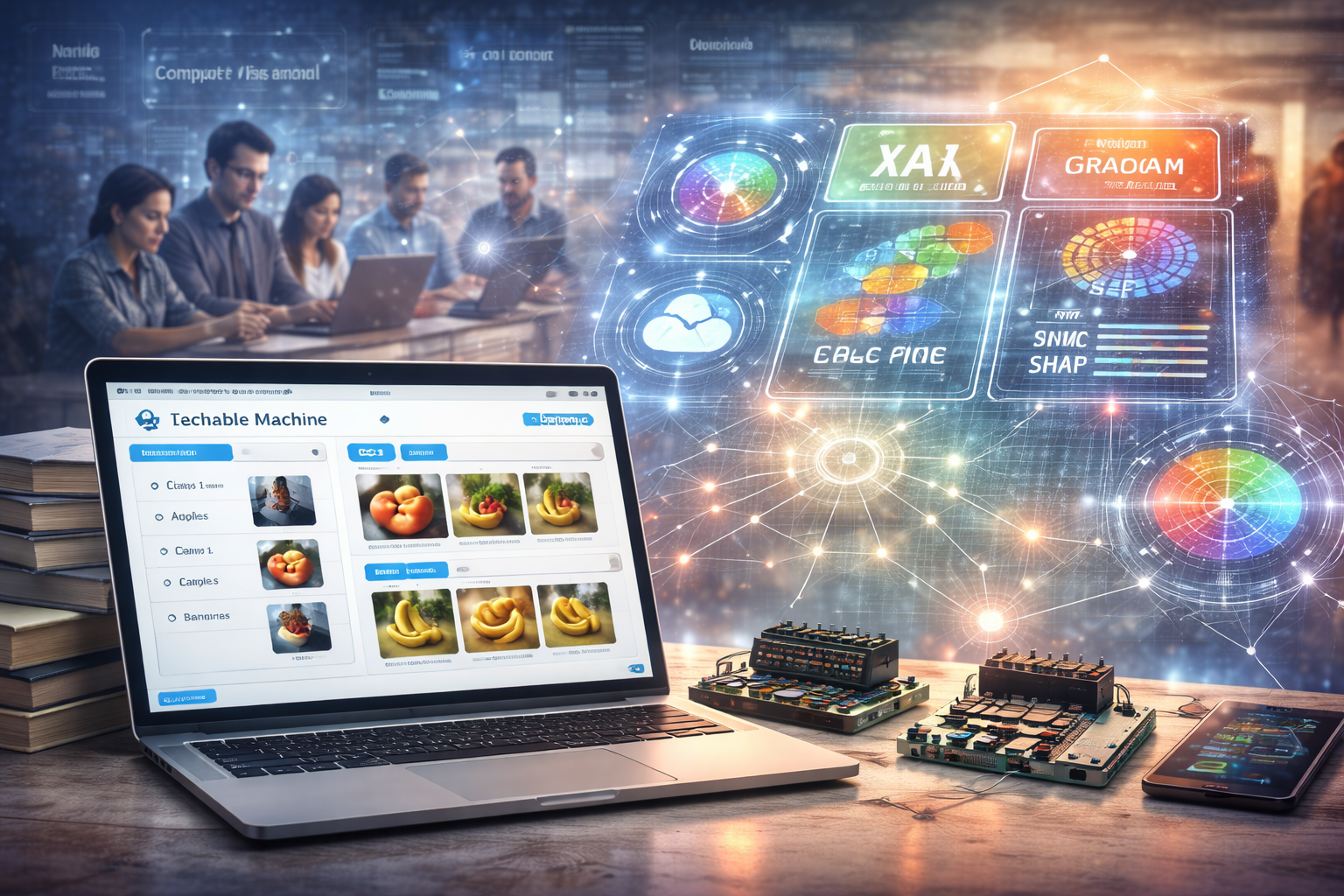
The first session, held on 05 November 2025 from 6:00 PM to 7:30 PM, focused on No-Code Computer Vision using Google Teachable Machine. This session introduced the concept of democratizing AI, enabling educators and non-programmers to build computer vision models without writing code. Participants explored how deep learning and computer vision work together through transfer learning using pre-trained models such as MobileNet. Key computer vision tasks—image classification, pose/gesture recognition, and audio classification—were demonstrated through hands-on examples, including fruit classification, gesture-based interaction, and fall detection for elderly care. The session also covered model testing, evaluation, deployment to web, mobile, and edge devices, ethical and responsible AI considerations, and the role of edge hardware such as Raspberry Pi and Jetson Nano in real-world applications.
The second session, conducted on 06 November 2025 from 6:00 PM to 7:30 PM, focused on Explainable AI (XAI) for Computer Vision. As deep learning models become increasingly complex, the session emphasized the importance of transparency, trust, and interpretability in vision-based AI systems. Participants were introduced to core XAI concepts, including why explanations are required, what needs to be explained in vision models, and the difference between model-specific and model-agnostic approaches. Practical techniques such as Grad-CAM, LIME, and SHAP were discussed to illustrate how heatmaps and feature attributions help interpret CNN predictions in tasks like defect detection, medical imaging, and surveillance systems.
Real-world case studies demonstrated how XAI supports debugging, bias detection, regulatory compliance, and human trust in AI systems. By linking the no-code vision models discussed in the first session with explainability techniques in the second, participants gained a holistic understanding of how accuracy and accountability must go hand in hand when deploying AI for computer vision applications.
Together, these two sessions provided a progressive learning journey—from building computer vision models visually using no-code tools to understanding and explaining deep learning decisions using XAI techniques. The active participation, questions, and reflections from faculty members highlighted the relevance of combining ease of adoption with responsible AI practices in teaching, research, and real-world deployment of computer vision systems.
Gratitude is extended to the Department of Computer Science & Engineering, Tripura Institute of Technology, Narsingarh, Agartala Aerodrome, Tripura–799009 for organizing this Advanced Computing FDP. Sincere appreciation is conveyed to Er. Gautam Pal, Associate Professor and FDP Coordinator, for his kind invitation and effective coordination of the program. Heartfelt thanks are also extended to Dr. Ankur Biswas, Associate Professor & Head of the Department and FDP Convenor, and Ms Sudeshna Das, Associate Professor and FDP Co-Coordinator, and all other esteemed members of the FDP organizing committee for their valuable guidance, and support in the successful conduct of the FDP. Appreciation is also due to the faculty and all participants for their enthusiastic engagement, curiosity, and insightful questions, which made the sessions highly interactive and enriching.